

Ever have one of those days where you feel like you're spinning your wheels, working hard but getting absolutely nowhere? The answer isn't to work harder; it's to learn how to get into flow state. Think of it as a neurological superpower for peak performance and, frankly, just enjoying your work more.
This state of deep immersion isn't some happy accident. It's a skill you can build with a bit of practice, helping you turn scattered effort into focused, meaningful output.
The Real Cost of Distraction and the Power of Flow
We've all been there. You walk into the office (or your home office) with a clear plan, only to have your focus shattered by a constant barrage of pings, emails, and shoulder taps. It's not just frustrating; it’s a massive drain on your actual performance and well-being.
The hidden cost of this kind of fragmented work is genuinely staggering. Picture this: you're at your desk in a bustling London office, ready to tackle a major project. But instead, you spend most of the day context-switching, and by the time you clock off, you've only managed 2 hours and 53 minutes of real, productive work in an 8-hour day.
This isn't a hypothetical; it's the reality for the average UK employee. In fact, only 21% of us feel truly productive for the whole day. This productivity black hole hits knowledge workers—founders, developers, writers, you name it—the hardest. You can dig into the full workplace productivity statistics in the StandOut CV analysis to see the scale of the problem.
This is precisely where understanding and engineering flow comes in.
What Is Flow State?
The term flow state was popularised by psychologist Mihaly Csikszentmihalyi to describe that mental state of being completely absorbed in what you're doing. It's the feeling of being "in the zone." Time melts away, your inner critic goes quiet, and the work itself becomes its own reward.
On a neurological level, your brain is firing on all cylinders, unlocking a higher level of focus, creativity, and problem-solving.
"Flow is being completely involved in an activity for its own sake. The ego falls away. Time flies. Every action, movement, and thought follows inevitably from the previous one, like playing jazz." - Mihaly Csikszentmihalyi
The good news is that flow isn't a fluke. It's a predictable state you can learn to trigger. By getting the conditions right, you can reclaim your focus and completely change how you work.
Here’s a quick comparison of a typical workday versus one where you successfully enter a flow state, showing the difference in both output and personal experience.
A Day With Flow vs a Day Without
| Metric | Typical Workday | Flow State Workday |
|---|---|---|
| Focus | Constantly interrupted, multitasking | Deep, single-task focus for 2-4 hours |
| Output | Low-quality work, small tasks completed | High-quality, significant progress on major projects |
| Time Perception | Day drags on, clock-watching | Time flies by without notice |
| Energy Levels | Drained, mentally fatigued by 3 pm | Energised, sense of accomplishment |
| Feelings | Frustration, stress, feeling behind | Satisfaction, enjoyment, confidence |
The contrast is stark. One day leaves you feeling depleted and unproductive, while the other leaves you feeling fulfilled and ahead of the game.
By mastering flow, you're not just getting more done. You're also tapping into:
- Sky-high Productivity: Crushing complex tasks in a fraction of the time it would normally take.
- A Creative Spark: Seeing new connections and coming up with genuinely novel ideas.
- Real Fulfilment: Finding deep satisfaction and even joy in the work you do.
This guide is your roadmap. It's packed with the rituals and environmental tweaks you need to start entering this powerful state on demand, making every single work session count.
Crafting Your Pre-Flow Ritual: The On-Ramp to Deep Work
Getting into a state of deep flow doesn't just happen. It's not a lightning strike of inspiration, but something you can cultivate. The secret lies in sending clear, intentional signals to your brain that it’s time to switch gears and dive deep. The most reliable way I’ve found to do this is by building a simple, repeatable pre-work ritual that acts as a trigger.
This doesn't have to be some elaborate ceremony. It's really about conditioning your mind and body to recognise that a session of intense focus is about to begin. Think of it like a pilot running through their pre-flight checklist; each step confirms you're ready and clears the path for a smooth journey into the zone.
This diagram shows that simple but crucial progression from distraction, through intentional focus, and finally into the flow state you're aiming for.
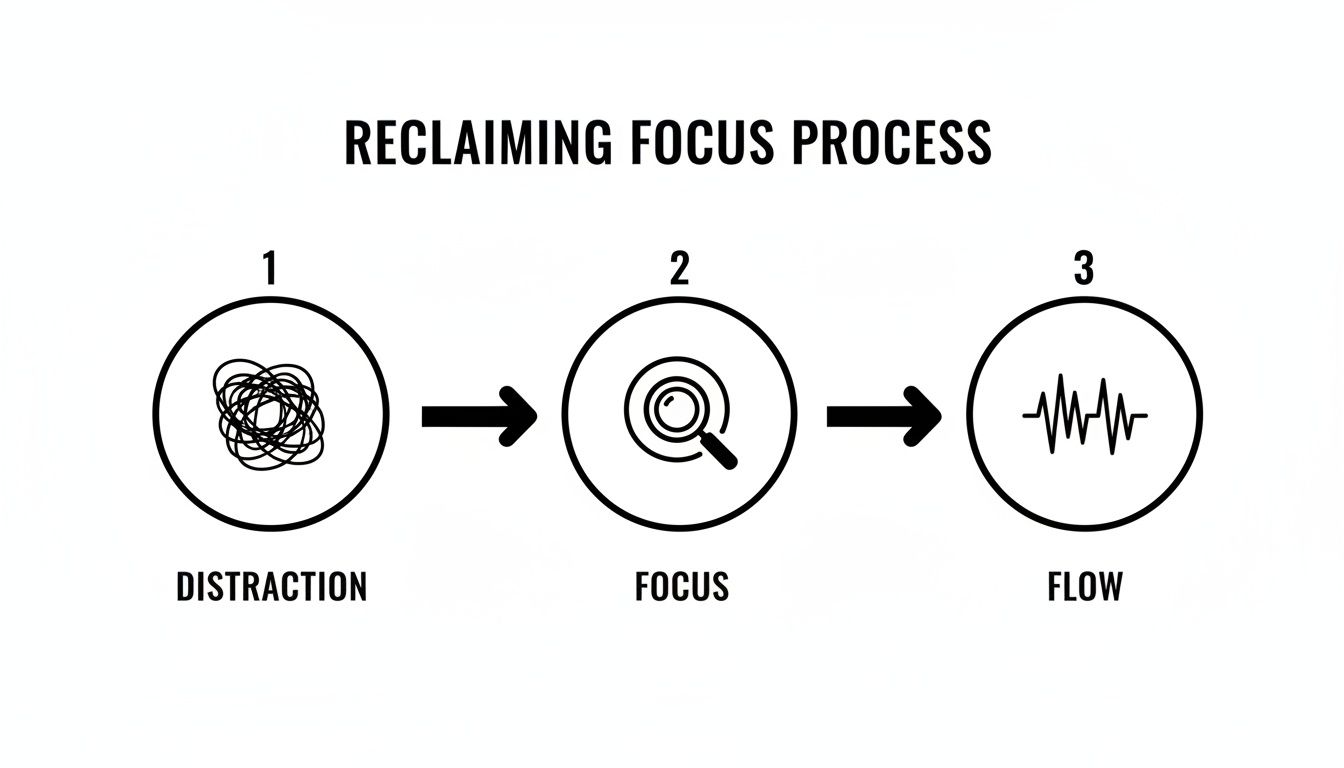
It’s all about actively moving from a scattered mental state to one of deliberate concentration. That focused state is the gateway.
Curate Your Environment
Your physical and digital spaces are littered with tiny hooks just waiting to snag your attention and pull you out of focus. Before you even think about the work itself, the first job is to mercilessly declutter your surroundings.
Start with your desk. Tidy it up. Put away anything that isn’t directly related to the task at hand—random papers, books you aren't using, yesterday's coffee mug. A clear space really does help create a clear mind.
Your digital desktop is just as important, if not more so.
- Kill the tabs: Your browser is probably the worst offender. Be ruthless. Close every tab related to social media, news, or other projects.
- Silence everything: Switch your computer to "Do Not Disturb" mode. Put your phone on silent and, ideally, move it out of your line of sight. Just having it nearby can drain your cognitive capacity.
- Go minimalist on-screen: Only open the apps and documents you absolutely need for this session. A cluttered screen is a recipe for a cluttered mind.
Define Your Mission
Flow thrives on clarity. You can't expect to drop into a state of deep focus if your brain is still trying to figure out what it's supposed to be doing. Before you start, you need to define a single, compelling objective for your work session.
This goal needs to hit that sweet spot: challenging enough to demand your full attention, but realistic enough that you actually believe you can do it. This is the challenge-skills balance, and it's a cornerstone of getting into flow.
A vague goal like "work on the project" is just an invitation for your mind to wander. A specific goal like "draft the three key arguments for the introduction" gives your brain a clear target to lock onto.
For instance, a developer about to start coding wouldn't just think "build the app." They might set a goal like: "Implement the user authentication endpoint and write the corresponding unit tests." It’s specific, it’s measurable, and it’s a manageable chunk of a larger challenge.
Activate Your Trigger
The final piece of this puzzle is creating a powerful sensory cue that tells your brain, "Right, it's time." This trigger is a specific, repeatable action you only perform right before a deep work session. With a bit of time, your brain forges a powerful link between this action and the intense focus that follows.
This psychological anchor, what some call a conditioned response, makes getting into the zone feel almost automatic. Your trigger can be anything, as long as it's simple and engages one of your senses.
Here are a couple of real-world examples:
- A Designer's Scent: Before diving into a complex wireframe, a designer might always light a specific scented candle or use a diffuser with a focus-friendly scent like rosemary or peppermint. That smell becomes an instant cue for creative concentration.
- A Writer's Brew: A writer could make a habit of brewing a particular herbal tea—maybe a ginkgo biloba blend—and only sip it when they're about to start writing. The ritual of taste and warmth becomes a powerful signal for deep thought.
You can also weave modern tools into this ritual. For those looking for an edge without turning to heavy stimulants, something like the Vibe Patch for sustained mental clarity can be a fantastic part of the trigger, offering a steady, discreet way to support your focus.
The key to all of this is consistency. Whatever you choose, make it the non-negotiable first step in your deep work routine.
Mastering Your Internal State with Breath and Sound
Once your physical and digital spaces are primed for focus, the real work begins internally. Getting into a flow state is less about brute-forcing concentration and more about skillfully managing your own physiology. This is where simple, science-backed rituals involving breath and sound can completely shift your internal landscape from scattered to settled.
You don’t need to become a meditation guru to feel the benefits. Think of these techniques as practical tools, designed to calm your nervous system and guide your brain into a state that’s receptive to deep, effortless concentration.
The Power of Intentional Breathing
Your breath is the most direct control panel you have for your nervous system. When you're stressed or distracted, your breathing is often shallow and erratic. By consciously shifting your breathing pattern, you send a powerful signal to your brain that it's safe to relax and focus.
It’s like downshifting your mental gears. Instead of fighting for focus, you're creating the biological conditions where it can arise naturally. You’re working with your body, not against it.
A couple of simple, incredibly effective techniques can make a world of difference.
Box Breathing: A Simple Start
This is a classic for a reason. It’s dead simple and remarkably effective at resetting your mental state. The structure is easy to remember and requires nothing but a few quiet moments before you dive into your task.
- Inhale slowly for a count of four.
- Hold your breath for a count of four.
- Exhale slowly for a count of four.
- Hold at the bottom for a count of four.
Repeat this cycle for just one or two minutes. You'll notice a significant drop in mental chatter and a feeling of calm readiness. It’s the perfect transition from a busy, reactive day into a focused work block.
The Physiological Sigh for a Rapid Reset
For those moments when you feel a sudden spike of anxiety or overwhelm, the physiological sigh is a godsend. It's a breathing pattern we instinctively do to offload stress, and you can trigger it on command.
It’s just two sharp inhales through the nose—the first one long, the second a shorter top-up—followed by one long, slow exhale through the mouth. Research has shown this can rapidly soothe the nervous system. Just one or two of these can be enough to pull your focus back from the brink.
Key Takeaway: Your breath is not just for survival; it's a tool for state management. Using a simple 60-second breathwork routine before a task can dramatically shorten the time it takes to enter deep focus.
Designing Your Personal Soundscape
Just as important as managing your internal state is curating your auditory environment. The right sound can act as a gentle guide, easing your brainwaves into a pattern that’s perfect for flow. This isn't just about putting on your favourite playlist; it's about strategically using specific types of audio to support, not distract.
Music with lyrics, for instance, can often backfire. Your brain tries to process the words, pulling attention away from what you're meant to be doing. Instead, consider sounds that create a consistent, unobtrusive sonic blanket.
- Binaural Beats: These work by playing slightly different frequencies in each ear, which your brain interprets as a single, rhythmic tone. Different frequencies are associated with different mental states, with alpha (8-13 Hz) and theta (4-7 Hz) waves being particularly linked to relaxed focus and creativity.
- Brown Noise: Deeper and more rumbling than white noise, many people (myself included) find brown noise exceptionally good at masking distracting background sounds without being harsh. It creates a steady, immersive audio environment that helps your mind settle.
- Ambient Soundscapes: Think of the gentle hum of a coffee shop, the sound of rainfall, or a calming drone. These soundscapes provide just enough auditory stimulation to keep your brain engaged without yanking your attention away from your main task.
Experiment to find what works for you. There are countless apps and websites like MyNoise or Brain.fm offering these soundscapes. The goal is to find a sound that you can put on and completely forget is there, allowing it to fade into the background while it underpins your concentration.
Combining a brief breathwork session with a carefully chosen soundscape creates a powerful one-two punch for kicking off a productive flow session.
Fuel Your Brain for Peak Performance

Getting into a state of deep focus isn't just a mind game—it’s a full-body experience. Your brain is a biological organ, and it needs the right kind of fuel to perform at its best. You wouldn't run a marathon after eating a bag of sweets, and you can't expect to achieve crystal-clear focus if you're not giving your brain what it needs.
So many of us fall into the trap of grabbing another strong coffee when we feel our focus dipping. While a little caffeine can be a helpful kick-start, too much is the enemy of flow. It can easily tip you over into a state of jittery anxiety, followed by the inevitable crash. That rollercoaster is the exact opposite of the calm, sustained concentration you're aiming for.
Ditch the Jitters and Aim for Stability
The sweet spot for flow is a state of alert calmness, not wired tension. This means we need to look beyond the "more caffeine" quick fix and find alternatives that support our brains without the nasty side effects. The real secret is maintaining stable blood sugar and avoiding those energy nosedives that kill your concentration.
Ever experienced that dreaded mid-afternoon slump? It's not a moral failing; it's a physiological signal. It’s often just your blood sugar crashing after a carb-heavy lunch or a sugary snack. When your energy levels tank, your ability to focus goes right down with them, making flow feel completely out of reach.
Here are a few ways to keep your energy steady:
- Go for Slow-Burn Fuel: Build your meals around protein, healthy fats, and fibre. Think things like avocado, nuts, seeds, and lean protein. These foods provide a steady, reliable stream of energy, preventing the sharp peaks and troughs you get from sugar and refined carbs.
- Hydration is Everything: Seriously. Even being just slightly dehydrated can mess with your cognitive function, bringing on brain fog and fatigue. Keep a water bottle on your desk at all times and make a habit of sipping throughout the day.
- Try Low-Caffeine Alternatives: Instead of that third espresso, why not try a green tea? It contains L-theanine, an amino acid known for promoting a state of relaxed focus. Or, you could explore functional drinks designed for mental clarity without the aggressive stimulants. For a plant-powered boost, our Vibe Drink for focus is specifically crafted to deliver a smooth, controlled lift.
My Takeaway: True mental endurance isn't about chasing stimulant highs. It's about creating a stable physiological foundation with smart nutrition and proper hydration. Get that right, and you're halfway to achieving deep, uninterrupted focus.
Work With Your Body's Natural Rhythms, Not Against Them
It’s not just about what you put into your body, but when you choose to do your most demanding work. Your energy isn't a single, massive tank you can just drain until it's empty. It ebbs and flows in natural cycles, and learning to ride these waves is a total game-changer.
We're all familiar with our daily circadian rhythm, but there are shorter cycles at play, too. These are called Ultradian Rhythms, and they’re the key to unlocking sustainable focus. Our brains can typically maintain a high level of concentration for about 90 to 120 minutes. After that, our performance naturally dips, and we need a short break to recharge.
Trying to power through this dip is a classic mistake. It just leads to burnout and sloppy work. The smarter approach is to structure your day around these natural energy cycles.
How to Structure Your Work for Flow
The Pomodoro Technique is a great example of this principle in action, breaking work into 25-minute chunks with short breaks. But for really deep work, you might want to stretch those intervals to align with your Ultradian Rhythms.
Here’s a simple way to do it:
- Block out 90 minutes for deep work. Commit to a single, high-priority task for a solid, uninterrupted 90-minute session.
- Take a proper break for 15-20 minutes. And by 'proper', I mean completely disconnect. Step away from the screen. Go for a walk, stretch, listen to some music—anything but work.
- Rinse and repeat. Most people can manage two or three of these high-quality deep work cycles in a day before their focus starts to fade for good.
Working in these focused sprints followed by genuine rest is the secret to avoiding burnout. It also makes it so much easier to drop back into a flow state when you return to your desk.
Troubleshooting Common Barriers to Flow
Even when you've done everything right—your ritual is dialled in, your intentions are set—the path to deep focus can still be a bumpy one. Life has a funny way of interfering. Your brain gets loud, a colleague wanders over, or the task itself feels either monstrously difficult or painfully dull.
Getting into flow is one thing, but knowing how to get back on track when you're knocked off course is just as important.
Think of these barriers less as failures and more as predictable hurdles. The trick is having a few simple tools ready to go when you feel your focus start to wobble, so you can pull yourself back in without derailing the whole session.
Taming the Noisy Mind
Let's be honest, one of the biggest showstoppers is the relentless chatter inside our own heads. Your mind races with a dozen different worries, nagging to-dos, and random thoughts, making it impossible to settle into what's in front of you. Trying to fight this mental noise is a losing battle. Acknowledging and offloading it is the way to go.
The most effective technique I've ever used for this is the brain dump. Before you dive into your work, take just two minutes. Grab a notepad and scribble down everything that's taking up space in your head.
- "Need to email Sarah back."
- "What if that client presentation goes badly?"
- "Don't forget to buy milk on the way home."
Get it all out. This simple act of writing it down externalises the thoughts and gives your brain permission to let them go for a little while. You've captured them, so you know they won't be forgotten. This frees up so much cognitive bandwidth for the actual task at hand.
In the UK's demanding work culture, it's no surprise that 67% of employees admit to feeling unproductive, often due to this kind of mental fog. Learning to manage your internal state is a powerful way to reclaim your focus. If you want to see the full picture of UK workplace productivity, you can discover more insights on LondonLovesBusiness.com.
Managing External Interruptions
A focused state is fragile. A single, unexpected tap on the shoulder or a Slack notification can shatter it in an instant. While you can't build a fortress around your desk, you absolutely can set clearer boundaries.
Most interruptions aren't malicious; people simply don't realise you're deep in concentration. A clear, visible cue can work wonders. This could be a small sign on your desk, wearing a chunky pair of noise-cancelling headphones, or blocking out "Focus Time" in your team's shared calendar.
And if someone does approach you, have a simple, polite script ready to go.
"Hey, I'm right in the middle of something that needs my full concentration. Can I come and find you in about an hour?"
This isn't rude; it's respectful to both their needs and your focus. You're not dismissing them, you're just deferring the conversation to a time when you can give them your full attention, protecting your precious flow state in the process.
Overcoming Task-Related Roadblocks
Sometimes the problem isn't your mind or your environment—it's the task itself. The work might feel so massive you don't know where to begin, or so boring you can't keep your mind on it. Both scenarios knock you out of that sweet spot between challenge and skill that flow requires.
When a task feels overwhelming: Break it down into almost laughably small pieces. A monster project like "Write the quarterly report" is intimidating. But "Outline the first section"? That's manageable. Your goal is to create a chain of small, achievable wins that build momentum. Once you've completed that tiny first step, the next one feels much less daunting.
When a task feels boring: This is your chance to get creative and add a layer of challenge. If you're stuck doing something repetitive, turn it into a private game. Can you get through this data entry 10% faster than you did last time? Can you find a cleverer way to organise these files? Introducing a self-imposed constraint or a time-based challenge can make even the most mundane work engaging enough to lock you in.
Your Flow State Questions, Answered
Even with a perfect plan on paper, a few questions always pop up when you start chasing flow for real. Let's tackle the most common ones I hear, clearing up any confusion so you can put this all into practice with confidence.
How Long Does It Really Take to Get into Flow?
It’s almost never like flipping a switch. You should plan for it to take a good 15-20 minutes of focused, dedicated effort to really drop into a flow state. Honestly, this is often the hardest part—that initial push against mental friction and the dozen little distractions calling your name.
This is exactly what your pre-flow ritual is for: to shorten that runway and make the transition feel smoother. The most important thing you can do is protect this 20-minute window like it’s sacred. Once you’re over that initial hill, you’ll feel the work itself start to pull you in, becoming more fluid and almost effortless.
Can I Get into Flow Without Caffeine?
Absolutely. In fact, for a lot of people, high doses of caffeine actually get in the way of flow. The jitters, the slight edge of anxiety, the scattered thinking… that’s the polar opposite of the calm, single-pointed focus that defines a true flow state.
Flow is all about sustained energy, not a frantic, temporary spike. You can get there far more reliably with a few non-stimulant tools in your arsenal:
- Breathwork to consciously calm your nervous system when you need it.
- The right soundscape, like brown noise or binaural beats, to create an immersive audio cocoon.
- Functional ingredients designed to support your brain and provide stable, long-lasting energy.
Many people find they hit a much deeper, more stable state of flow by dialling back their caffeine or cutting it out completely. The goal is calm alertness, not wired tension.
What If My Job Is Full of Interruptions?
This is a tough one, but it’s the reality for most of us. It doesn't make flow impossible, you just have to change your strategy. Instead of aiming for long, uninterrupted days, you have to create and defend short, intense "focus sprints".
Block these out in your calendar as if they're client meetings. A 60 or 90-minute slot is often a realistic goal. During this time, you have to be ruthless. Let your team know you're diving deep.
My go-to trick: Change your Slack or Teams status to something like 'Deep Work – back at 11 am'. Turn off every single notification on your phone and computer. If you can, find a quiet spot away from the main buzz of the office. Even one solid flow session a day can make a massive difference to your output on high-value tasks.
For the rest of the day, batch your smaller tasks together. Deal with all your emails in one go instead of letting them poke you every ten minutes. It’s about being intentional with your time and energy.
Is Flow Just for Work, or Can I Use It for Hobbies Too?
Flow is universal. It’s a state that can elevate pretty much any activity that demands skill and concentration. It’s especially powerful for creative work, studying, or even gaming.
- For Creatives: Flow is where your inner critic finally shuts up and you can connect ideas in new ways. Whether you're a writer, designer, or musician, it’s the state where your best, most original work emerges.
- For Students: Dropping into flow while studying is the secret to deep learning and better memory. You’re properly engaging with the material, not just skimming it, which helps lock it into your brain.
- For Gamers & Athletes: This is that classic "in the zone" feeling. Time seems to slow down, your reflexes are sharp, and you're just reacting perfectly, making split-second decisions without overthinking.
The principles are always the same, no matter what you’re doing. You need a clear goal, zero distractions, and a challenge that’s just hard enough to keep you completely absorbed.
Ready to build a ritual for calm, on-demand focus? HIGH offers a complete system of plant-powered drinks, discreet patches, and guided audio designed to help you own your state. Find your focus in the full collection
Published via Outrank


